Choosing the right tile adhesive is an important part of any successful tiling installation. But with classifications such as C1, C2, S1 and S2 appearing on packaging and technical data sheets, understanding what they mean can help you select the right tile adhesive for your project.
In this guide, we’ll explain the different tile adhesive classifications and the key differences between S1 and S2 tile adhesives.
What do C1, C2, S1 and S2 classifications mean?
Cementitious tile adhesives are commonly classified according to EN 12004, with the classification providing information about the adhesive’s performance and characteristics.
You may see classifications including:
C1 – standard cementitious adhesive
C2 – improved cementitious adhesive
T – reduced slip
E – extended open time
F – fast setting
S1 – deformable adhesive
S2 – highly deformable adhesive
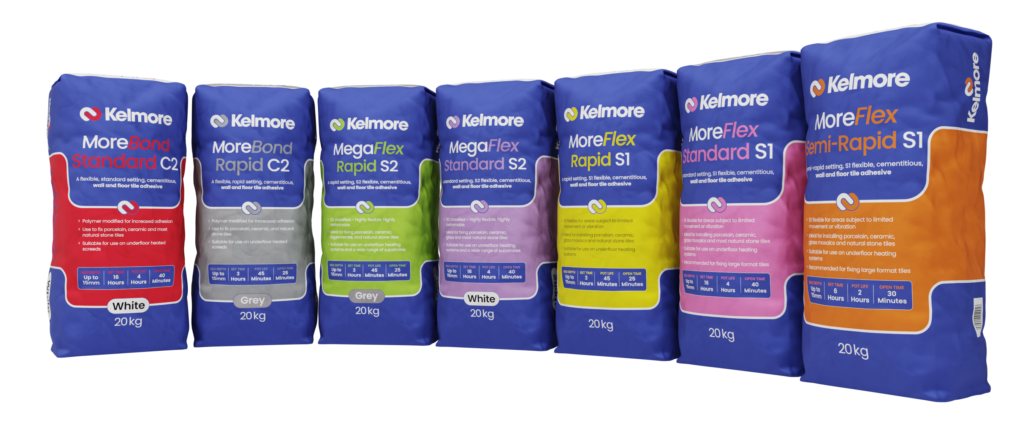
These classifications can be combined to describe multiple characteristics of an adhesive. For example, Kelmore’s MoreFlex Standard S1 is classified as a C2TE S1. This classification means it is an improved cementitious adhesive with reduced slip, extended open time and deformability, often referred to as flexibility.
Kelmore’s adhesive range are all classified as C2 with the MoreFlex range offering additional S1 flexibility and the MegaFlex range offering even greater flexibility.
What is an S1 tile adhesive?
An S1 tile adhesive is classified as a deformable adhesive, with a deformation capability of between 2.5 mm and 5 mm under the EN 12002 classification system.
This flexibility allows the adhesive to accommodate areas with limited movement and vibration within the tiling installation. This can be particularly important where substrates expand and contract or where temperature changes may cause movement.
S1 adhesives are suitable for applications such as underfloor heating, where repeated heating and cooling cycles can result in movement. Depending on the installation and tile type, they may sometimes be used in conjunction with an uncoupling membrane, such as LokStar Membrane, to help accommodate movement. Kelmore’s S1 adhesives are also suitable for external use, bathrooms, wet rooms and installations involving numerous tile types, including large-format, porcelain, ceramic and natural stone.
What is an S2 tile adhesive?
An S2 tile adhesive is classified as a highly deformable adhesive, with a deformation capability of 5 mm or greater.
This provides a greater degree of deformability than an S1 adhesive, making S2 adhesives suitable for installations where higher levels of movement and vibration may need to be accommodated.
As with an S1 adhesive, an S2 adhesive can be particularly useful when tiling over underfloor heating systems. Depending on the product and system requirements, an S2 adhesive may also be suitable for demanding external applications and other installations where a higher level of deformability is required.
S1 vs S2 tile adhesive: what is the difference?
The main difference between S1 and S2 tile adhesives is their level of deformability.
S1 provides a deformable solution, with deformation between 2.5 mm and 5 mm, while S2 is highly deformable, with deformation of 5 mm or greater. An S1 adhesive may be suitable where a moderate degree of movement needs to be accommodated, while an S2 adhesive may be more appropriate for installations where greater movement or vibration is expected.
This doesn’t mean that S2 is automatically a better choice than an S1. The correct tile adhesive depends on the specific requirements of the installation. For example, an S1 adhesive may be suitable where moderate movement is expected, but where greater movement or vibration is expected, an S2 adhesive may be more appropriate for the project.
Choosing the right tile adhesive
Understanding C1, C2, S1 and S2 tile adhesive classifications makes it easier to compare products and select an adhesive suitable for your project.
When choosing between an S1 and S2, consider the tile type and size, substrate, location, moisture exposure, temperature changes and expected movement. By understanding tile adhesive classifications and selecting a product designed for the conditions of your installation, you can help achieve a reliable and durable tiled finish.
Always check the manufacturer’s technical data sheet to confirm that the adhesive is suitable for your particular project.
Written by Alex Dawson, Technical Support Specialist at Kelmore.
Our Technical Support Team is available Monday – Friday, 8:00am – 4:30pm on 01257 830511 or technical@kelmore.co.uk. Please don’t hesitate to contact us for any advice or support.