What was your first ever job?
Paul
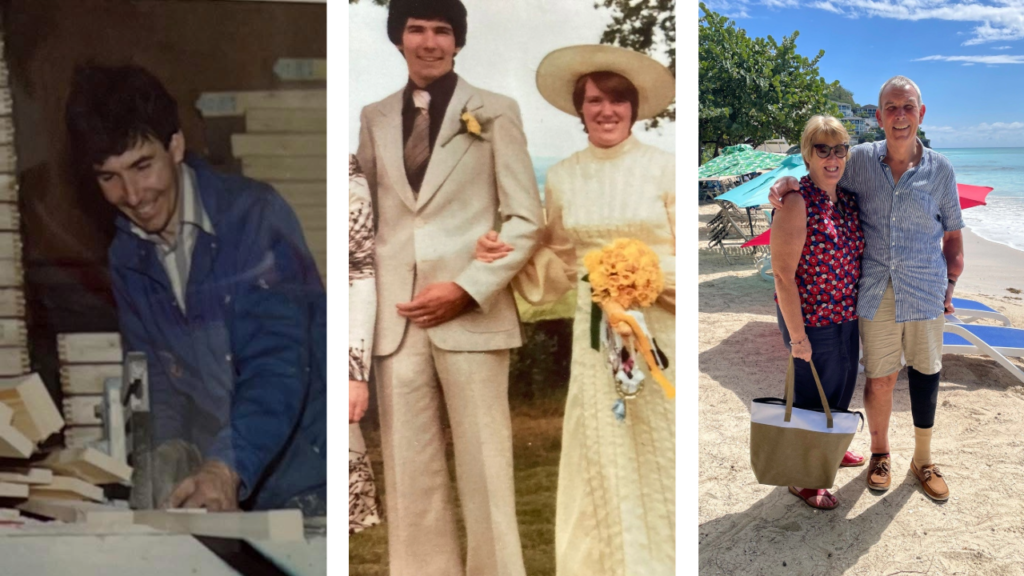
My first job reflected the career path I originally thought I would follow. I planned to go into graphic design and got a summer job at a wallpaper mill in Withnell Fold. I worked in the trimming department, collecting the offcuts from six printing machines and baling them up.
During that time, the company discovered I was interested in graphic design. The gentleman who mixed the colours for the wallpaper was retiring, and the manager asked whether I would like to train as a colour mixer. I remember thinking, I’m earning money, I love motorbikes and I could buy a motorbike! I decided to give it a go, telling myself that if it didn’t work out, I could always return to graphic design.
In the end, things progressed quickly. I moved through different roles within the mill, learned a lot and, most importantly, that’s where I met Rhona and fell in love.
Rhona
My first job was also at the paper mill. At the time I was studying at college to become a primary school music teacher, but many of my friends seemed to be enjoying working life more than I was enjoying college. The paper mill was the nearest place to where I lived, so I applied for a job there and started working in finance.
What has been your favourite job?
Paul
I’ve had so many jobs and, honestly, I’ve never really had a bad one. I loved working at the paper mill. I enjoyed the people, the opportunities and the progression.
What I did learn, though, was that when you’re employed by someone else you’re not entirely in control of your own future. Sometimes I felt I was more qualified for certain roles, but other people interviewed better or presented themselves differently and progressed ahead of me.
That made me realise that I wanted to run my own business. I’d always wanted that, even back when I was interested in graphic design. The mill gave me invaluable experience in understanding people, training others and learning how businesses operate.
One of my favourite periods was when I first went into business making pasting tables. It was hard work, but incredibly rewarding. I employed six young lads who joined us through an apprenticeship scheme when they were only 16 or 17 years old. Even now, decades later, we still meet up twice a year. They’ve never forgotten those days and neither have I.
More recently, after my accident and with Mark joining the company, I was able to step back from the shop floor and spend more time planning for the future. That’s brought a different kind of satisfaction.
One of the nicest things about business is the relationships you build over the years. We recently visited a customer we’ve known for more than 35 years. The son of the owner we first dealt with all those years ago is now coming to fit a floor in our home. It’s lovely to see those connections continue. People are good, there are far more good people than bad and that’s something we really enjoy.
Rhona
Working in finance taught me a lot, but my favourite role was being at home with the children when they were young.
During the evenings, once Paul came home, I taught piano and swimming lessons privately, and I also worked behind the bar a few nights a week. Those jobs never really felt like work because they were sociable and gave me a chance to get out and meet people. Meanwhile, Paul would take over looking after the children.
What led you into the industry?
Paul
I’d always wanted to run my own business. I don’t believe you need to be an expert to succeed, I think attitude is the most important thing.
I started out making pasting tables. When that market declined, my business partner decided to move on. As part of a deal, we ended up with a ribbon blender mixer. I looked at it and thought, What can I do with this?
A good friend of mine, Gary, was a chemist, so I asked him whether he could formulate a product that we could manufacture using the mixer. He said yes, and that’s how we got into tile adhesives and levelling compounds. The rest, as they say, is history.
What’s a moment your especially proud of?
Paul and Rhona
That’s a difficult question because there have been so many proud moments.
The births of our children and grandchildren stand out immediately. Another would be when we first got married, we had very little money. We went around family members collecting bits of furniture for our first home. One person would give us a table, another some chairs. Our house was filled with all sorts of mismatched items. To look at where we’ve come from and where we are now is something I’m very proud of.
Winning awards such as the BIBAs was also wonderful, but I’m really proud of our family, our values and the way we’ve tried to do things properly. I’m proud to be a Kelly and proud to share experiences with good people.
What is it really like working together as a married couple?
Rhona
For many years I kept my own jobs separate because Paul was setting up the previous business and it was helpful to have another income stream to support them. I did the wages for the business from home, and everything was done manually in those days.
Paul would tell employees what they would take home each week without taking tax, National Insurance and everything else into account. It used to drive me mad because I had to work backwards to make the figures add up!
I only joined the business full-time when it moved from Whittle-le-Woods to Leyland in 2011. Mark said, “Mum, we could really do with you coming in to help with the accounts.” From then on, I stayed until we sold the business.
Paul
I used to keep receipts in a carrier bag. Rhona also did accounts for other businesses, and she would go mad because I’d lose receipts for things like cream cakes.
She once spent an Easter weekend trying to finish the books and eventually threw them back at me and said, “That’s it. I’m not doing them anymore if you can’t keep your receipts!”
How do your strengths complement each other?
Paul
Let’s say I’m the dreamer and Rhona is the organiser.
I’m the person who says, “Let’s do this!” and assumes it’ll all work out. Rhona is systematic, practical and grounded. You need both personalities to succeed.
Rhona
I’ve always been practical and good at stretching a budget. I used to save whatever was left over from the housekeeping each week, and we joined the Christmas Club at the local shop, putting aside a small amount every week to pay for presents. You had to make things work with what you had.
What keeps you motivated when faced with challenges?
Paul and Rhona
As you get older, you realise you just have to get on with things. The love we have for each other and for our family keeps us going.
Who or what inspires you?
Paul
As a child, my hero was Lord Nelson. I loved his story and admired his determination.
I’m also a huge fan of Robert Plant from Led Zeppelin.
More than anyone, though, I would say Rhona’s dad, Dougie Wilkinson, inspired me. He was a true gentleman. He served during the war, survived being sunk at sea twice and took part in the D-Day landings. He was an extraordinary man.
Rhona
My parents inspired me because they worked incredibly hard in the family butchers’ shop. My mum used to sit me in a highchair in the shop while she worked, and I think that’s where my love of being around people came from.
My first manager in finance also taught me a great deal and gave me confidence.
Paul
There was also my boss at the paper mill. When he found out we were getting married, he said, “You’re not earning enough to get a mortgage, so I’m going to arrange for your wages to be increased so you can buy a house.”
People like that leave a lasting impression.
What is the best piece of advice you’ve ever received?
Rhona
My dad always said because he was in the family business, “If you ever do anything wrong, tell me. If you don’t tell me, I’ll find out anyway.”
It taught me to always be truthful, honest and polite.
Paul
The best advice I received was to treat everyone the same and show people respect.
One of our employees had the opportunity to become a locomotive driver with British Rail. He was a huge part of our business, but I encouraged him to take the opportunity because it was right for him.
You should never hold people back for your own benefit.
Who’s more likely to:
Take risks?
Paul
Stay organised?
Rhona
Come up with big ideas?
Paul
Make last minute decisions?
Paul
Keep things calm under pressure?
Rhona
Spot a new opportunity?
Paul
Think big picture?
Paul
More likely to be late?
Paul (Paul made the point he isn’t more likely to be late, its just Rhona’s more likely to be early!)
What’s something people might be surprised to learn about you?
Paul
My childhood surprises many people.
My father was a highly skilled diesel engineer. My brother was born in Peru, and I lived there for four years. I actually spoke Spanish better than English when we returned home.
Later, we spent time in Nigeria when I was between 11 and 13 years old, during the Nigerian Civil War. I witnessed poverty, hardship and conflict at a young age, which shaped my outlook on life. I remember one occasion vividly – my mum loved reading and we were in a library early one morning, around seven o’clock, when a bomb exploded about 50 metres away from us.
Rhona
I was chosen to present flowers to Princess Margaret when she opened our new school, which was very exciting.
I remember being called to the headteacher’s office and my mum thinking, “What on earth has she done?” I actually had a terrible cold at the time, so everyone was even more worried! But instead of being in trouble, I was being asked to present the bouquet to Princess Margaret, which was a lovely honour.
People are also surprised by the variety of jobs I’ve done over the years. I’ve been a piano teacher, swimming instructor, barmaid and worked in a butcher’s shop, as well as in finance.
What does the future hold for Kelmore?
Paul
The future is bright. We’ve built an amazing team and we genuinely enjoy sharing our success with the people around us.
Job satisfaction is incredibly important. We want everyone to leave work at the end of the day with a smile on their face. That creates camaraderie, respect and a positive atmosphere throughout the business.
We do things properly, our customers recognise that, and as long as we continue to maintain those standards, the future looks very good.
Rhona
For me, it’s all about the team. Everyone gets on well, and there’s a real sense of warmth and friendliness as soon as you walk into Kelmore.
Even though we’re not involved every day now, we’re still included and kept informed, which is lovely. That’s a reflection of the culture that’s been created here.