We recently launched LokStar Membrane, an advanced uncoupling membrane with dovetailed cavities for superior tile adhesion. Knowing when and why to use it can help prevent tile cracking and related issues.
In this blog, we’ll explore when you should use an uncoupling membrane in your project.
What is an uncoupling membrane?
An uncoupling membrane is a layer installed between the subfloor and tiles. It helps protect tiles from lateral movement, preventing cracks and structural stress from damaging your tiled surfaces.
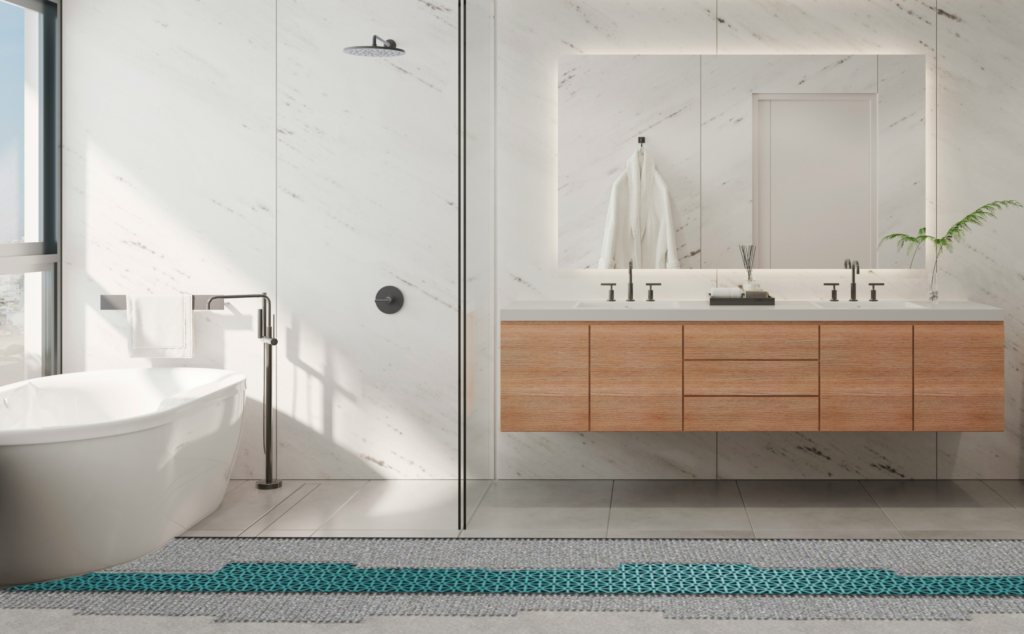
When installed with sealed joints and appropriate waterproofing tape, uncoupling membranes can form a continuous waterproof system. They are ideal for use with underfloor heating systems.
Common terms for an uncoupling membrane include:
- Decoupling Membrane
- Anti Fracture Mat
- Crack Mat
5 scenarios when to use an Uncoupling Membrane
- Prevent cracks and substrate movement
All building materials naturally expand and contract as temperatures and moisture levels change. This is an important consideration in flooring installations.
Uncoupling membranes absorb lateral floor movement and prevent cracks from transferring to tiles. Without one, movement is directly transmitted to the tiles, potentially resulting in cracked tiles, damaged grout lines, and tile lifting.
They are especially useful for thin and large-format tiles.
Key benefits:
- Reduces stress on grout and tiles
- Maintains tile integrity over time
- Optimising underfloor heating installations
Installing tiles over underfloor heating systems presents unique challenges due to constant temperature changes, which can cause thermal expansion and substrate movement.
By incorporating an uncoupling membrane such as LokStar, you create a protective buffer between the heating system and the tile finish. This allows for independent movement between layers, helping to prevent cracks caused by thermal expansion and contraction.
- Protect wet or moisture-prone areas
As part of a waterproofing system uncoupling membranes can provide an effective waterproof layer beneath the tiled surface, helping to prevent water ingress and protect both the substrate and the finished floor.
- Installing tiles over timber floors
Timber expands and contracts with changes in temperature and humidity, which can lead to tile cracking or debonding over time.
An uncoupling membrane provides a reliable solution by creating a separation layer between the substrate and the tiled surface, allowing each layer to move independently and reducing stress transfer to the tiles.
Although proper subfloor preparation remains essential, an uncoupling membrane can help manage lateral movement and protect the tiled finish from potential issues.
- Streamlining tiling installation
Fully embedding LokStar in adhesive during installation helps to create a strong, even bond to the subfloor by removing air pockets and achieving full surface contact, improving overall system performance.
LokStar Membrane features a unique dovetailed cavity design, which enhances mechanical adhesion by allowing tile adhesive to securely lock into the membrane. This results in a secure bond between the tiles and the uncoupling membrane, improving durability and long-term reliability.
Why use LokStar Membrane for your tiling project
Whether you’re installing tiles over underfloor heating, preparing moisture-prone spaces, or working with uneven substrates, LokStar Membrane helps protect your investment.
By reducing the risk of cracking and simplifying installation, it ensures your tiled surfaces remain durable and flawless for years to come.
Written by Chris Pratt, Technical Support Manager at Kelmore.
Our Technical Support Team is available Monday – Friday, 8:00am – 4:30pm on 01257 830511 or technical@kelmore.co.uk. Please don’t hesitate to contact us for any advice or support.