When preparing a floor, selecting the right levelling and smoothing compound can make the difference between a durable, aesthetically pleasing installation and an unsightly or costly flooring failure.
With multiple options available such as ultra-rapid setting, fibre-reinforced and multi-purpose, it’s important to select the product that suits your substrate, depth requirements and project timeline.
This guide will walk you through exactly how to choose the perfect levelling compound for your needs.
Understand your subfloor type
The first step is identifying what surface you’re working with as different substrates may require different formulations.
Common subfloors include:
- Sand:Cement Screed
- Concrete
- Plywood Overlay
- Tile Backer Boards
- Asphalt (Flooring Grade)
- Epoxy Damp Proof Membranes
- Existing Porcelain, Natural Stone and Ceramic Tiles
- Metal or Steel
- Calcium Sulphate/Anhydrite Screed
Some self-levelling compounds can be bonded directly, while others require backgrounds to be primed or are specially formulated for problematic substrates.
Tip: Always check that the levelling and smoothing compound is compatible with your specific subfloor before application. You can find full details on substrate compatibility for our levelling and smoothing compounds here.
Check the depth you need to level
Some levelling compounds are designed to work within specific thickness ranges.
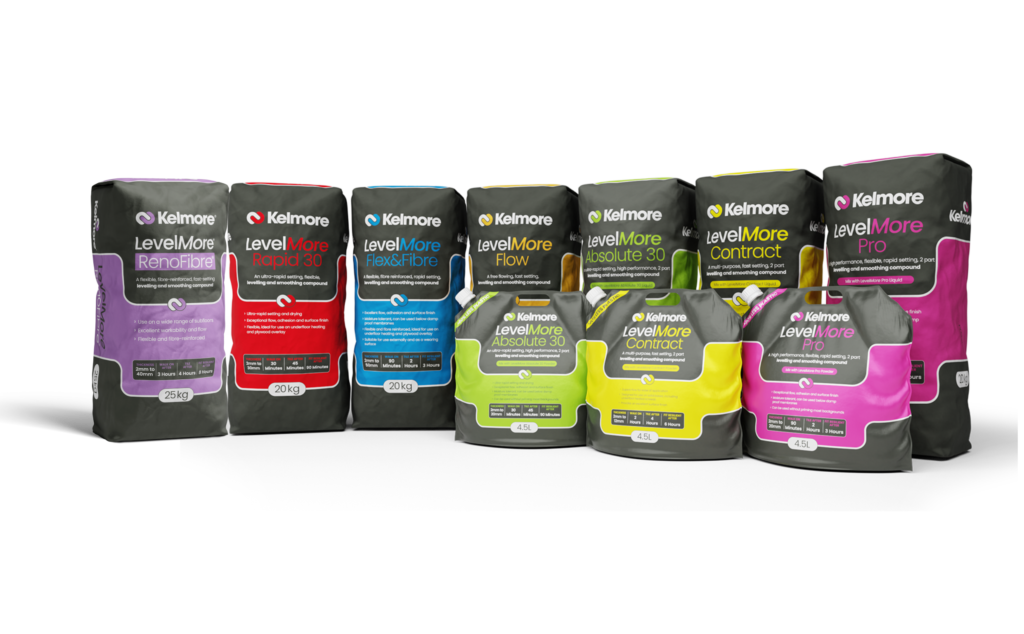
- For depths between 2-12mm – LevelMore Contract may be suitable for the area.
- For depths between 2-20mm – LevelMore Pro and LevelMore Absolute 30 may be suitable for the area.
- For depths between 2-25mm – LevelMore Flow may be suitable for the area.
- For depths between 2-30mm – LevelMore Rapid 30 may be suitable for the area.
- For depths between 2-40mm – LevelMore RenoFibre may be suitable for the area.
- For depths between 2-75mm – LevelMore Flex&Fibre may be suitable for the area.
Tip: Always measure the deepest point of the floor before selecting your product, as using a compound outside its recommended depth range can lead to cracking and extended curing.
Consider drying and curing time
If you’re working in a commercial environment or on a tight renovation schedule, ultra-rapid setting levelling compounds can save you a significant amount of time.
Ultra-rapid setting self-levelling compounds such as LevelMore Rapid 30 and LevelMore Absolute 30 can be ready for resilient floor coverings in as little as 90 minutes and tiling as little as 45 minutes.
Slower setting compounds may require 8 hours or more depending on temperature and site conditions.
Tip: Drying times are heavily influenced by temperature and humidity. In colder, more humid conditions, levelling and smoothing compounds can take significantly longer to dry. In these situations, using a rapid-setting compound may help keep your project on schedule. Conversely, in warmer temperatures, drying and curing times can be reduced as the compound will set faster.
Is the compound suitable for internal or external use?
Not all levelling and smoothing compounds are suitable for external applications. While all our compounds are suitable for internal use, only LevelMore Flex&Fibre is suitable for external use.
Do you need a compound to be used as a wearing surface?
For domestic settings, LevelMore Flex&Fibre can be used as a wearing coat, but it must be applied at a minimum thickness of 6mm to ensure durability.
For commercial environments, where floors are subject to heavier use or more movement, the requirements can vary. In these cases, it’s best to contact Kelmore’s Technical Department for advice on the right compound and application method.
When should you use a fibre-reinforced levelling compound?
Fibre-reinforced compounds such as LevelMore Flex&Fibre and LevelMore RenoFibre enable thicker application depths. By enhancing tensile and flexural strength, the fibres reduce the risk of cracking and shrinkage during curing, improve impact resistance, and enhance stability when used over flexible substrates such as plywood and underfloor heating systems.
Final checklist before choosing your levelling and smoothing compound
Before selecting your levelling and smoothing compound you will need to consider:
- Subfloor type
- Required thickness
- Drying time needed
- Final floor covering
- Internal or external use
- Expected traffic levels
- Whether flexibility is required
Need help choosing the perfect levelling and smoothing compound?
If you’re unsure which levelling and smoothing compound is right for your project, speak to a member of Kelmore’s technical team. Choosing the correct product from the start helps prevent installation failures, saves time on site, and ensures a professional finish every time.
Written by Craig Powell, Head of Technical at Kelmore.
Our Technical Support Team is available Monday – Friday, 8:00am – 4:30pm on 01257 830511 or technical@kelmore.co.uk. Please don’t hesitate to contact us for any advice or support.